

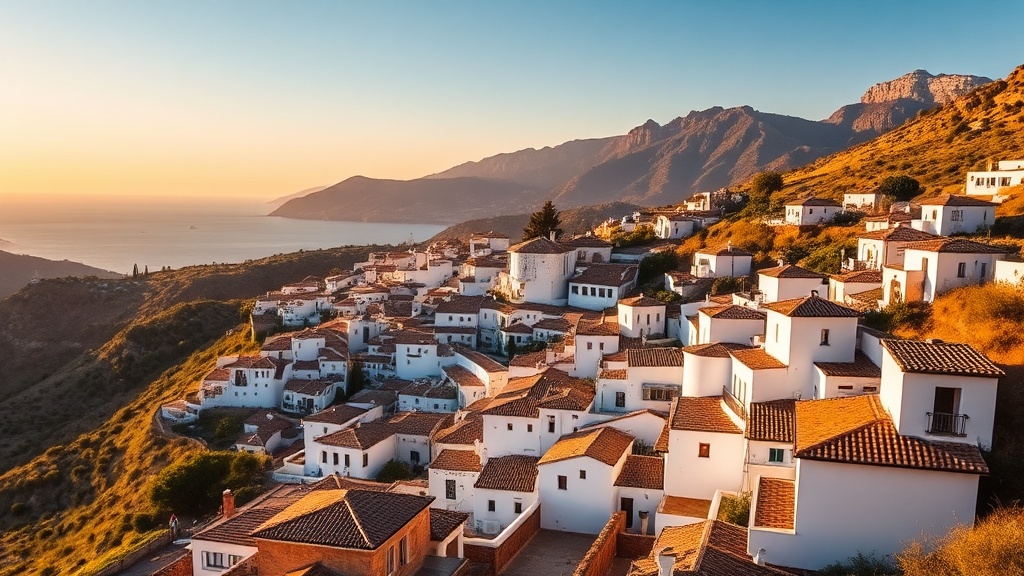
Nestled in the foothills of the Sierra de las Nieves, just ten minutes from Marbella’s glittering coast, Ojén remains one of the Costa del Sol’s most compelling yet overlooked investment opportunities. While international buyers flock to the beaches and golf courses below, a growing number of astute investors are turning their attention to this whitewashed mountain village where property values tell a different story.
The question isn’t whether Ojén offers investment potential—it’s whether you’re positioning yourself before the broader market catches on.
The Geographic Advantage That Changes Everything
Location drives property value, and Ojén’s positioning is exceptional. Perched at 300 metres above sea level, the village offers something increasingly rare on the Costa del Sol: proximity to Marbella’s infrastructure without the premium pricing that comes with a Marbella postcode.
The journey to Puerto Banús takes fifteen minutes. Málaga Airport sits forty-five minutes away via the AP-7. Yet property prices in Ojén typically run 30-40% below equivalent homes in nearby coastal developments. This price differential creates an obvious arbitrage opportunity that won’t last indefinitely.
More importantly, Ojén’s elevation provides natural advantages that coastal properties simply cannot match. Summer temperatures run several degrees cooler. Air quality improves dramatically above the coastal haze. Views extend across the Mediterranean to the African coast on clear days. These aren’t marketing features—they’re tangible benefits that drive long-term demand among discerning buyers.
Infrastructure Development and Market Momentum
Recent infrastructure improvements have fundamentally altered Ojén’s accessibility profile. The improved A-355 road connection has cut travel times to the coast, while ongoing developments in nearby Marbella and Benahavís are pushing buyers to explore adjacent areas with similar appeal but lower entry points.
The village itself has seen thoughtful expansion. New residential developments blend traditional Andalusian architecture with modern amenities, attracting both permanent residents and second-home buyers seeking authentic Spanish character without sacrificing convenience. The municipality has maintained strict planning controls, ensuring development remains sympathetic to the village’s heritage—a regulatory environment that protects long-term property values.
Water infrastructure has been modernised, addressing historical concerns about supply during summer months. High-speed internet connectivity now reaches most areas, making remote work feasible and broadening the potential buyer pool beyond retirees and holiday home seekers.
The Rental Market Reality
Property investment isn’t solely about capital appreciation—yield matters. Ojén’s rental market demonstrates strength across multiple segments.
Long-term rentals benefit from demand from professionals working in Marbella who prefer quieter residential environments. Monthly rental rates have climbed steadily over the past three years, with well-maintained properties commanding €1,200-€2,000 monthly depending on size and finish.
The short-term rental market proves equally robust. Travellers seeking authentic Andalusian experiences increasingly bypass generic coastal apartments in favour of village properties with character. Occupancy rates during peak season regularly exceed 80%, with nightly rates for quality properties reaching €150-€250. The village’s proximity to hiking trails in the Sierra de las Nieves Natural Park adds appeal for active tourists, extending the rental season beyond traditional beach months.
Crucially, Ojén’s rental market hasn’t faced the same regulatory pressures as Marbella’s town centre, where short-term rental restrictions have tightened considerably. This regulatory breathing room provides investors with greater flexibility in how they monetise their assets.
Price Trajectory and Market Fundamentals
Over the past five years, property prices in Ojén have appreciated by approximately 25-30%, outpacing inflation but trailing the explosive growth seen in premium coastal developments. This moderate appreciation suggests a market driven by genuine demand rather than speculative excess.
The buyer profile has evolved noticeably. Five years ago, Ojén attracted primarily Spanish buyers seeking weekend retreats. Today, Northern European buyers—particularly from the UK, Germany, and Scandinavia—comprise roughly 40% of transactions. These international buyers typically bring higher budgets and longer holding periods, stabilising the market against short-term volatility.
Supply constraints work in investors’ favour. The village’s mountainous topography naturally limits developable land, while planning restrictions prevent the kind of oversupply that has plagued some coastal areas. New construction remains measured, keeping inventory tight and supporting price stability.
Comparing Investment Options on the Coast
Every investment decision involves opportunity cost. How does Ojén stack up against alternatives along the Costa del Sol?
Coastal apartments in Marbella’s New Golden Mile offer strong rental yields but come with significantly higher entry costs and increasing maintenance fees as developments age. Detached villas in established areas command premium prices that make attractive yields difficult to achieve unless you’re playing purely for capital appreciation over extended timeframes.
Sotogrande presents a compelling luxury market, but prices reflect its established prestige—entry points for quality properties typically exceed €800,000, placing them beyond many investors’ range. Benahavís offers similar mountain appeal to Ojén but prices have already adjusted upward as buyers discovered its charms.
Ojén sits in that sweet spot: discovered enough to have proper infrastructure and amenities, but not so discovered that prices have fully capitalised the location’s inherent advantages. Entry points for renovated village houses start around €200,000, while modern villas with pools and views range from €400,000-€700,000—price brackets that remain accessible to a broad investor base.
Risk Factors Worth Considering
No investment case is complete without acknowledging potential downsides. Ojén’s mountain location means properties face different maintenance considerations than coastal equivalents. Winter brings more rainfall, requiring attention to drainage and roof condition. Older properties may need significant renovation, and costs can escalate if structural issues emerge.
The village’s appeal relies partly on its authentic character, which means amenities remain more limited than in larger towns. No major supermarkets operate within the village centre, though several exist ten minutes away in Marbella. For some buyers, this represents precisely the appeal—for others, it’s a dealbreaker.
Currency exposure affects international investors. Euro strength or weakness against your home currency impacts both acquisition costs and repatriated rental income. Brexit has added complexity for UK buyers, though Spanish residency pathways remain open for property investors meeting minimum investment thresholds.
Finally, property taxes in Spain aren’t negligible. Annual property tax (IBI) runs approximately 0.4-0.7% of cadastral value, while rental income faces standard income tax treatment. These ongoing costs need factoring into yield calculations.
The Timing Question
Markets move in cycles, and timing matters. Several indicators suggest Ojén’s investment window remains open but may be narrowing.
Transaction volumes have increased by roughly 35% over the past two years, signalling growing buyer interest. International property portals have begun featuring Ojén more prominently in Costa del Sol searches. Local estate agents report increased enquiries from investors specifically asking about areas adjacent to Marbella with growth potential.
These aren’t signs of an overheated market—transaction volumes remain well below peak levels seen in coastal hotspots. Rather, they suggest a market in transition from overlooked to recognised. For investors, that transition period typically offers the most attractive risk-reward dynamics.
Making It Work
Successful property investment in Ojén requires more than identifying the opportunity—execution matters. Work with agents who understand the local market rather than those focused purely on coastal properties. They’ll identify properties with genuine rental potential rather than houses requiring excessive renovation.
If pursuing rental income, prioritise locations with good road access and parking. Village centre properties offer charm but limited parking can deter some renters. Properties on the village periphery with mountain views often achieve better rental performance while maintaining authentic appeal.
Budget realistically for renovation if buying older properties. Spanish tradespeople work to high standards but rural locations can mean higher transport costs. Factor 15-20% contingency beyond initial quotes—surprises emerge once walls open up.
Consider property management if you’re not Spain-based. Quality management companies charge 15-20% of rental income but handle everything from guest communication to maintenance coordination. For investors treating this as a genuine asset rather than a hobby, professional management makes financial sense.
Property investment in Ojén isn’t a get-rich-quick scheme. It’s a measured play on a location whose fundamentals—proximity to established demand centres, constrained supply, improving infrastructure, and attractive pricing—create conditions for sustained appreciation and reliable income. The village won’t become the next Marbella, but that’s precisely why the investment case holds merit. Sometimes the smartest money doesn’t chase what everyone else is buying—it positions itself just ahead of where the crowd is heading.